What is Salesforce AppExchange and why build on it?
Introduction
Salesforce is highly flexible and usually utilizes a lot of customization, but its real power comes from extensibility. That’s where AppExchange enters the picture.
The AppExchange is Saleceforce’s own marketplace of applications and solutions that help with different business task to be solved withing your goal.
By using AppExchange tools, instead of building everything from scratch, companies and developers can leverage a ready-made ecosystem of apps, components, and services designed specifically for Salesforce.
In this article, we’ll break down:
What Salesforce AppExchange is;
What you can find there;
Why businesses and developers rely on it;
And whether building on AppExchange makes strategic sense at all (spoiler - yes, it does!);
By Salesforce’s data, there is more than 91% of Salesforce customers use AppExchange to support their business. It means that demand is definitely existing and people are looking for solutions.
What Is Salesforce AppExchange?
Salesforce AppExchange is the official marketplace for Salesforce solutions, where businesses can find apps, integrations, components, and consulting services tailored to their CRM environment.
The hub is something like Apple App Store — but for enterprise software. It is focused entirely on Salesforce ecosystem and built for both users (buyers) and partners (builders).
Key characteristics:
Thousands of ready-to-install solutions;
Millions of installs and active users;
Strong ecosystem of partners and developers;
Peer reviews and ratings guiding decisions;
How Salesforce AppExchange work in practice you may ask?
The apps on Exchange help Salesforce users to speed up operations, extend SF capabilities, simplify complex processes “from the box” right after installing the app into your system.
For developers it works kinda like a launchpad. You receive resources and direct access to users who already utilized Salesforce and need solutions.
What Can You Find on AppExchange?
AppExchange is not just “apps.” It’s a broader ecosystem, let’s dive into more details.
1. Apps and Prebuilt Solutions
CRM extensions;
Automation tools;
Industry-specific solutions;
AI and analytics integrations;
These solutions plug directly into Salesforce and extend its functionality without heavy development, only configuration is needed.
2. Components and Frameworks
Lightning pre-made components;
Reusable UI/logic blocks;
Accelerators for faster development;
These are especially relevant for developers building custom solutions and cut the costs a lot.
3. Consulting and Implementation Partners
Certified Salesforce consultants;
Agencies for custom builds;
Integration and migration experts;
This turns AppExchange into both a product marketplace and service directory.
4. Free and Paid Offerings
Free tools (including Salesforce Labs apps);
Subscription-based SaaS products;
Enterprise-grade paid solutions;
Also, we can point some more: Bolt Solutions (templates that combine all of the points above), Flow Solutions (Automated flows for common processes), B2C Commerce Solutions (Integration junks for B2C), Tableau Accelerators (Prebuilt dashboards and workbooks), Data Cloud solutions (Apps to activate, orchestrate data in Data Cloud).
Salesforce AppExchange pricing models
Pricing of course vary. It depends on the type of sultions, but there are a lot of listing that are free. Ones that are paid often include different possibilities to utilize:
Monthly/annual plans;
One-time fee;
Freemium;
Paid add-ons (Base is free, extra is paid);
Usage-based plans (API usage as an example)
That allows developers to align product vision to the goals of customers and niche functionality and at the same time Salesforce users are able to choose what suits them best.
Why AppExchange Exists
Salesforce itself cannot cover every use case across every industry. Business usually grow internal teams or use the help of outsource agencies, the companies that don’t have neither support are using AppExchange and it solves the internal/external support absense by enabling:
Rapid extension of Salesforce capabilities;
Reduced need for custom development;
Faster time-to-value for businesses;
So, instead of building features internally, companies can install and configure solutions in a few clicks.
Benefits of Using AppExchange
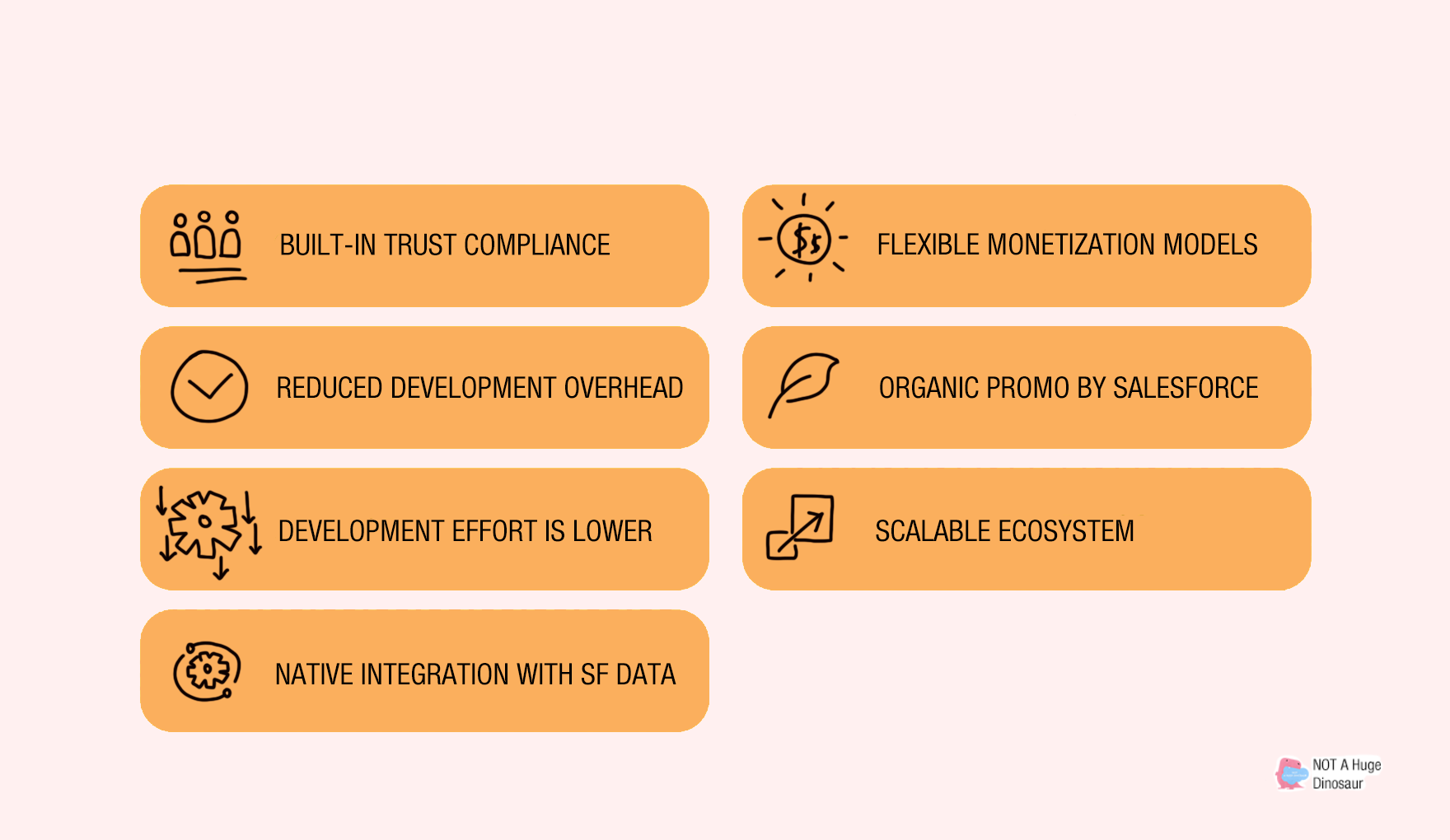
Building an AppExchange app gives you a lot: product credibility, reach a global network of 150k lоуаl SF users, rating and trust into your brand. If you have a ready-made solution, to pack it into the app is a great idea, especially if you have growth and monetization in mind. AppExchange offers an extensive infrastructure to launch, sell and scale your idea.
Main benefits are:
Built-In Trust and Compliance
Salesforce enforces a rigorous security review process, which directly impacts how your product is perceived. Once your application passes this evaluation, it signals to customers that your solution complies with Salesforce standards for data protection and system reliability.
This results in several practical advantages:
Reduced friction in sales conversations - less effort spent proving credibility;
Stronger brand association through alignment with Salesforce;
No need to build complex security systems from scratch, as many safeguards are already embedded in the platform;
Reduced Development Overhead
Building a product independently often requires significant investment in infrastructure, authentication systems, data architecture, and security layers.
Developing within the Salesforce ecosystem eliminates much of that burden:
Core infrastructure (hosting, user access, security) is provided by Salesforce;
Development cycles are shorter due to tools like App Builder, Flow, and native APIs;
Licensing and version control are handled through built-in platform capabilities;
Maintenance and updates are streamlined within the ecosystem;
In practice, this means less time spent on foundational engineering and more focus on product functionality and market growth. It also shortens time-to-market, since infrastructure-related delays are largely removed.
Native Integration with Salesforce Data
AppExchange solutions operate directly within Salesforce’s data model, rather than relying on external connections. This is a significant structural advantage compared to standalone applications.
Key capabilities include:
Direct access to standard objects such as Leads, Opportunities, and Cases without additional connectors;
Native triggering of workflows, approvals, and automation logic;
Simplified integration with external systems via supported APIs;
Consistent handling of permissions, layouts, and field-level security;
Real-time data updates and shared visibility across teams;
As a result, your application behaves as an extension of Salesforce rather than an external add-on.
Flexible Monetization Models
AppExchange supports multiple pricing strategies, allowing you to align monetization with your product and market positioning.
You can:
Offer subscriptions, one-time purchases, usage-based pricing, or free tiers;
Manage licensing and renewals through Salesforce’s License Management App (LMA);
Start with a free or limited version and expand into paid plans over time;
Use a dedicated Salesforce environment to manage customers and sales processes;
A common pattern among developers is to validate demand with a free offering before introducing premium tiers.
Increased Visibility Through the Platform
AppExchange provides exposure beyond your own marketing efforts. High-performing applications may receive additional promotion from Salesforce itself.
This can include:
Featuring in AppExchange newsletters and curated lists;
Increased discoverability within marketplace search and recommendations;
Reinforced credibility through platform endorsement;
For early-stage products, this visibility can significantly influence adoption speed.
Access to the Salesforce Partner Ecosystem
Publishing on AppExchange typically involves becoming part of the Salesforce Partner Program. This opens access to a broader network of tools, resources, and industry participants.
After onboarding, you can:
Collaborate with other partners on integrations or joint offerings;
Participate in co-marketing initiatives;
Leverage shared expertise across the ecosystem;
These opportunities are difficult to replicate outside the Salesforce environment.
Scalability and Continuous Evolution
Salesforce is a continuously evolving platform, and applications built on it benefit from that progression.
This provides:
The ability to scale across organizations and regions without major rework;
Faster rollout of new features once the product is live;
Ongoing platform-level improvements handled by Salesforce;
From an operational standpoint, AppExchange applications are generally easier to maintain, update, and scale within existing Salesforce environments.
Benefits of using AppExchange
Why Build on AppExchange? (For Developers & Agencies)
This is where the strategic value becomes more interesting.
1. Built-In Market Demand
You are not launching into an empty market.
Salesforce already has a massive customer base;
Users actively search for solutions inside AppExchange;
High intent audience (not cold traffic);
This significantly reduces customer acquisition friction.
2. Distribution Channel + Marketplace
AppExchange acts as:
Product directory;
Lead generation channel;
Trust layer (via reviews and Salesforce branding);
You get visibility without building your own distribution from zero.
3. Trust and Credibility
Publishing on AppExchange signals:
Security compliance;
Salesforce ecosystem alignment;
Product maturity;
Brand trust;
This is especially important for enterprise buyers.
4. Monetization Opportunities
You can:
Sell SaaS subscriptions;
Offer freemium models;
Upsell services or integrations;
AppExchange supports multiple pricing strategies.
5. Ecosystem Leverage
You build on top of:
Salesforce APIs;
Data models;
Platform capabilities;
Meaning:
Less infrastructure work;
Faster product iteration;
Easier integrations;
Types of AppExchange Solutions (For Builders)
If you plan to build, you typically fall into one of these categories:
Managed Packages
Fully controlled by vendor;
Upgradeable;
Preferred for commercial apps;
Unmanaged Packages
Open and customizable;
Often used as templates or accelerators;
When Building on AppExchange Makes Sense
You should consider it if:
Your product is tightly tied to Salesforce workflows;
You target Salesforce users specifically;
You want faster go-to-market;
You prefer leveraging an existing ecosystem over building distribution;
When It Might Not Be Ideal
Your product is platform-agnostic;
You need full control over infrastructure;
Your audience is outside Salesforce ecosystem;
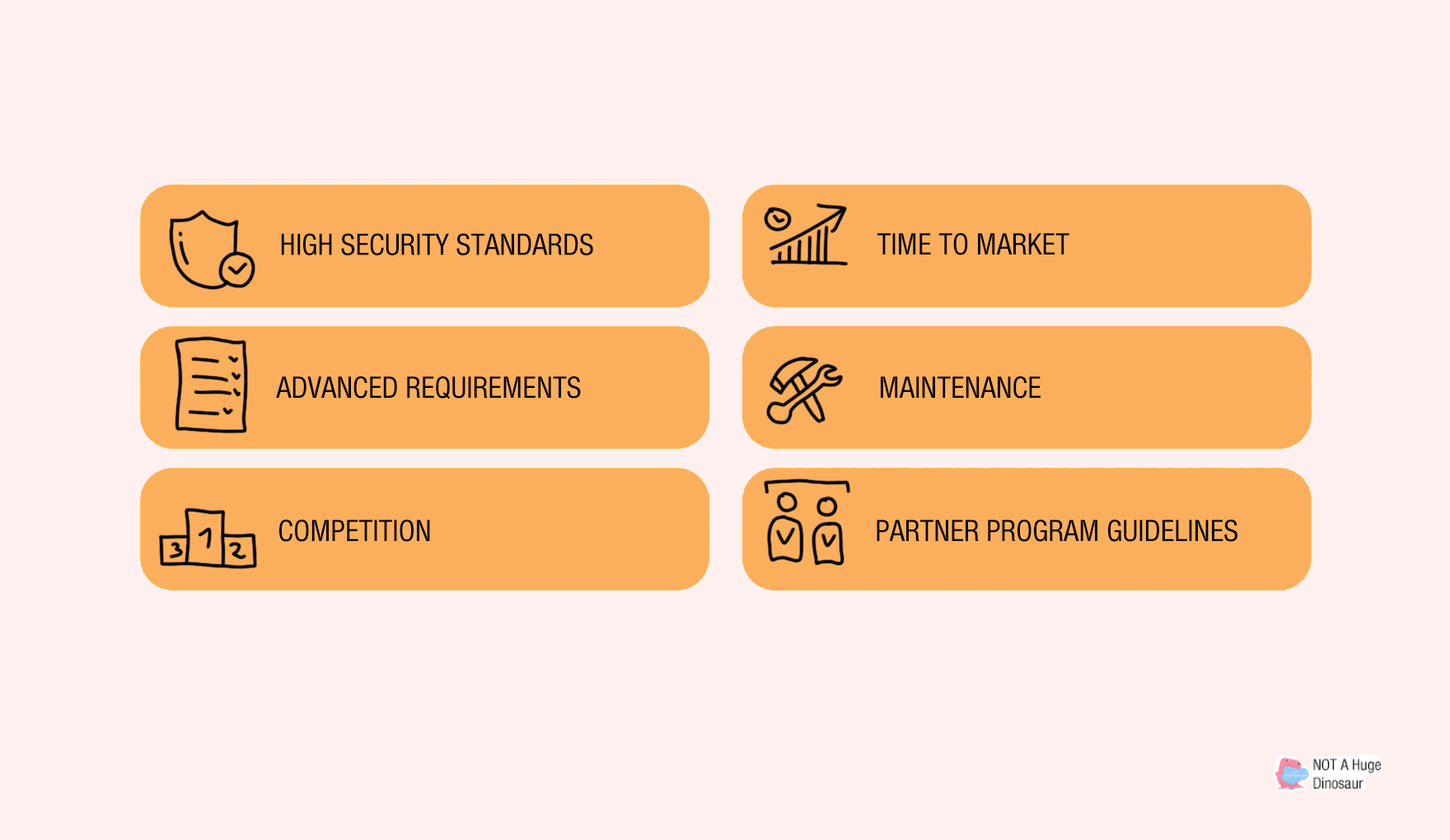
Before You Hit “Publish”: Key Challenges to Consider
Building for Salesforce AppExchange creates clear opportunities, but it also introduces constraints. The process requires structured planning, familiarity with the platform, and adherence to Salesforce standards.
Before moving forward, it’s worth evaluating the main challenges:
Strict Security Requirements
Salesforce enforces high security and compliance standards.
Every app must pass a formal security review and mandatory scans;
Documentation is required throughout the process;
A Business Review may include feedback on pricing and positioning;
These steps are not optional and can extend timelines if issues are identified.
Steep Learning Curve
Publishing on AppExchange assumes a solid understanding of the Salesforce ecosystem.
Technologies like Apex, Lightning components, and managed packages have specific constraints;
Platform architecture differs significantly from typical web development;
Even experienced developers may face friction without prior Salesforce exposure. In many cases, teams rely on specialists with AppExchange experience.
High Competition
The marketplace is already saturated with established solutions.
Many apps solve similar problems;
Users compare based on reviews, features, and clarity of value;
Without a clearly defined use case and differentiation, new products tend to get overlooked.
Time-to-Market Constraints
Although Salesforce provides development tools and prebuilt components, publishing is not immediate.
The review and approval process alone can take several weeks;
Delays often occur due to configuration or documentation gaps;
This needs to be factored into any go-to-market planning.
Ongoing Maintenance Requirements
Launching an app is not a one-time effort.
Regular updates are required to maintain compatibility with Salesforce releases;
Bug fixes and performance improvements are expected;
Customer feedback must be addressed continuously;
In practice, AppExchange products require long-term operational support.
Partner Program Entry
Access to AppExchange requires joining the Salesforce Partner Program.
Includes application review, legal agreements, and business validation;
Approval is structured and may take time;
While not prohibitive, it adds an additional layer before publishing.
Conclusion
Salesforce AppExchange is more than a marketplace — it’s a distribution engine, ecosystem, and validation layer for Salesforce-based solutions.
For businesses, it simplifies extending CRM capabilities.
For developers and agencies, it provides direct access to a high-intent market with built-in trust.
Building on AppExchange is not just a technical decision — it’s a strategic one:
Faster entry;
Lower acquisition cost;
Stronger positioning within the Salesforce ecosystem;
If уоu іntend to create a рroduct that lasts and sells – experience matters. Hire our AppExchange developersand sее how professionals bring your idea to market – together with уou.
Things to consider building on AppExchange
FAQ
-
AppExchange is designed to extend Salesforce functionality. It acts as a marketplace where users can browse, assess, and install solutions that integrate directly into their Salesforce environment. Whether it’s automating renewals, handling licensing, or monitoring usage across teams, relevant tools are typically available.
-
In principle, anyone can develop and publish an app. In practice, doing so without Salesforce-specific expertise is difficult. Many companies partner with certified PDOs (Product Development Outsourcers) to handle development in line with Salesforce requirements, streamline the security review process, and manage the product lifecycle from initial concept to release.
-
If your target users already operate within Salesforce, AppExchange provides direct access to that audience inside their existing workflow. This reduces adoption friction and increases the likelihood of regular product usage compared to external platforms.
-
Yes. A freemium approach is common. Offering limited functionality at no cost helps attract early users and validate demand. AppExchange supports multiple pricing models, including free tiers, trials, and enterprise licensing.
-
Yes. NOT A Huge Dinosaur supports the full development cycle — from building and testing to navigating AppExchange requirements. This reduces time spent on rework, improves alignment with Salesforce standards, and helps bring the product to market more efficiently.